
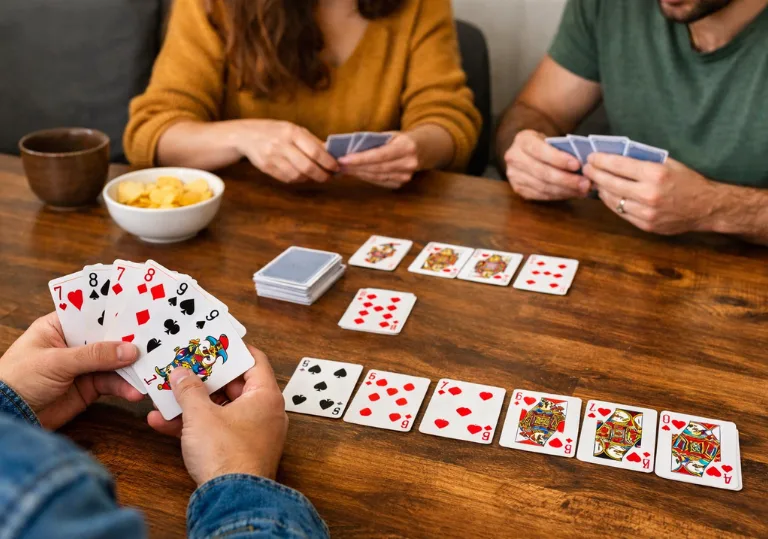
Most people don’t discover Rummy 91 by planning to.
It usually happens mid-conversation. Someone says, “Let’s play 91.” And for a second you pause. Ninety-one what? Cards? Points? A variation?
It’s not a new game. Not really.
Rummy 91 is simply a points-based format of rummy where elimination happens at 91 points. That’s the whole twist. You start at zero. You collect penalty points when you lose rounds. And when your total hits 91 or more, you’re out.
That’s it.
But that small number — 91 — changes the mood at the table more than you’d expect.
What Is Rummy 91, Really?
If you strip it down, this format follows standard rummy rules. The deck doesn’t change. The sequences stay the same. Sets follow familiar rules. Even the declaration process remains unchanged.
The only difference is the scoring cap.
Players begin with zero points. After each round, the players who didn’t declare successfully add the value of their unmatched cards to their total score. Those numbers accumulate slowly. Or quickly. Depends on the night.
Once someone reaches 91 points, they’re eliminated from the session. The game continues with the remaining players until only one person is left under the limit.
It sounds simple because it is simple. But simple formats tend to expose mistakes faster.
The Setup Feels Familiar
You sit down. Cards are shuffled. Thirteen cards per player. One card face up to start the discard pile. The rest form the draw pile.
Two to six players is typical. More is possible, but smaller groups move better. There’s less waiting. Less drifting.
Each turn involves drawing a card and discarding one. The focus usually shifts quickly toward building a pure sequence first — that part always matters. Without it, nothing else counts. Then you try to arrange the rest into sets or additional sequences.
The mechanics don’t surprise anyone who has played rummy before. What surprises people sometimes is how quickly the scores creep up in this format.
The 91-Point Rule and Why It Matters
Here’s where the tension sneaks in.
Card values are straightforward. Number cards carry face value. Face cards count as 10 points. Aces usually count as 10. Jokers are zero.
After someone declares, you look at what’s left in your hand. Maybe it’s a 9, a Queen, and a 5 that never connected. That’s 24 points added to your total.
It doesn’t feel heavy in the first round. Twenty-four points is manageable. But if something similar happens again next round? Now you’re at 48. Then maybe another rough hand takes you past 70.
Suddenly, 91 doesn’t feel like a large number.
That’s the quiet pressure of this format. It builds without drama.
Elimination Isn’t Loud — It’s Gradual
No one is knocked out in a single move unless something went very wrong.
Instead, players drift toward the edge. One reaches 80 points and becomes careful. Another sits at 65 and takes a risk. Someone else might hover safely at 20 for a while — until they don’t.
When a player crosses 91 points, they step out. No reset. No second chance within that session. The rest continue.
The game narrows slowly, almost casually, until only one player remains below the threshold.
And that narrowing feels different from longer formats like 201-point pool rummy. In those games, you have room to recover from a bad stretch. In this one, the cushion is thinner.
The Drop Option — A Small Escape
Many tables allow a drop. If your opening hand looks… chaotic, you can exit early and accept a fixed penalty instead of risking a larger one later.
It’s tempting. Sometimes practical.
But if you drop too often, those fixed penalties add up too. You might avoid one big loss but accumulate several medium ones instead.
It becomes a judgment call. And judgment shifts from night to night.
The Flow of a Session
A round ends. Scores are updated. Cards are reshuffled. It starts again.
The rhythm stays steady. What changes is how people play once totals rise. A player sitting at 85 points doesn’t play the same way they did at 15.
You see it in small decisions. Discards become safer. High cards are released earlier. Risks shrink.
And because there’s no fixed number of rounds, the length of the session depends on how evenly penalties spread across the table. Sometimes one player falls behind quickly. Other times everyone moves in small increments, and the game stretches longer than expected.
Still, compared to 201-point formats, Rummy 91 usually wraps up sooner. The ceiling is simply closer.
Is Rummy 91 Skill-Based?
Like any rummy variation, it’s a mix.
The cards you receive are random. You can’t control that part. But how you arrange them, what you hold, what you discard, and when you declare — those choices matter.
In this format, consistency becomes noticeable. You don’t need spectacular rounds. You need fewer damaging ones.
It’s not about dramatic wins. It’s about avoiding repeated losses.
Where This Format Is Played
Rummy 91 can be played casually at home with physical cards. It can also appear on digital platforms that offer pool-style scoring structures. The name refers to the elimination number, not a specific brand.
Rules may vary slightly between tables, especially around drop penalties or scoring caps per round. So it helps to clarify before starting.
That small conversation at the beginning saves confusion later.
This format can also appear on digital platforms that support pool-style scoring. In some cases, players may encounter it on an example of a third-party platform, although rules and availability can vary by region.
Final Thoughts
Rummy 91 doesn’t reinvent the game. It tightens it.
The cards don’t change. Sequences follow familiar patterns. And there’s still that quiet satisfaction when everything aligns just before you declare.
What shifts is the margin. Ninety-one points isn’t far away once penalties start stacking. The format rewards steady play, cautious decisions, and awareness of the scoreboard.
It feels familiar. Just a little sharper around the edges.
And sometimes, that’s enough to make the table feel different — even when the cards are the same.
For readers who want to explore other structured rummy formats and scoring variations, additional explanations are available in the FreeBonus777 gaming guides, where different card game rules are broken down in a clear and practical way.
Frequently Asked Questions
It refers to the elimination limit. Once a player accumulates 91 penalty points or more, they are out of the session.
No. The combinations and declaration rules remain the same. Only the scoring cap changes.
There’s no set number. The game continues until only one player remains under 91 points.
Generally, no. Face cards and aces are usually 10 points, number cards keep face value, and jokers count as zero.